


HISAKO International is an ISO 9001 and MSME certified manufacturer and global exporter of rice, spices, pulses, and value-added food products. Based in India with global operations, we deliver lab-tested, food-safe products through reliable internat...
- (+91) 9538000215
- hisako.intl@aol.com
- 1st floor, 1st block, #17, METADESK, 19th H Main, Rajajinagar, , Bengaluru, Karnataka, India. 560010
© 2020 Hisako International OPC pvt ltd. All Rights Reserved
Coca Powder
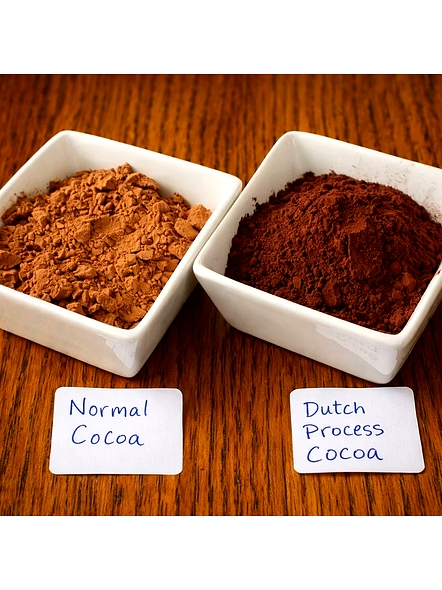
Coca Powder – Coca Powder For B2B Wholesale, Import, and Distribution Supply
Coca Powder in the Coca Powder category for routine B2B purchasing. Use it when you need to stock, quote, or ship Coca Powder under a consistent name for buyers. Streamline your sourcing with a single, clearly identified SKU for procurement and resale.
Features:
- Coca Powder positioning for standard B2B ingredient sourcing and resale workflows.
- Product named as Coca Powder for straightforward quoting, PO matching, and catalog setup.
- Confirm required grade, cut, or format with your buyer before bulk packing or shipment.
- Request current packaging and batch documentation if your market requires traceability.
Attributes:
- Brand/Seller: Hisako for supplier identification across orders and logistics paperwork.
- Category: Coca Powder to align with your internal SKU and marketplace taxonomy.
- Product name: Coca Powder for consistent labeling in listings and invoices.
- If dimensions, moisture, or certifications matter, confirm exact specs before ordering.
- Check country-specific import requirements and request documents when not explicitly stated.
A. Category definition
This category covers Coca Powder offered as a collection of options for B2B sourcing and repeat procurement. Items in this category are typically purchased as ingredients or inputs where consistency, lead times, and pack formats matter more than consumer branding.
Includes:
- Food-grade powders for manufacturing and foodservice
- Different roast and processing styles and flavor profiles
- Baking and confectionery inputs for recipes and mixes
- Bulk packs for industrial throughput and private label
- Variants focused on color, aroma, and dispersibility
- Options suited to beverage, dairy, and dessert applications
Excludes:
- Finished consumer snacks and beverages
- Equipment or machinery used for processing
- Single-use samples marketed as retail-only items
Examples (from input signals):
- Coca Powder
B. What these products are used for
Products in the Coca Powder category are commonly used to add flavor, color, aroma, or functional performance in food and beverage formulations. They support scalable production workflows where buyers need predictable results across batches, whether for manufacturing, foodservice preparation, or private-label packing.
They are also used to standardize recipes, reduce prep time, and simplify inventory by using pre-processed formats that integrate smoothly into mixing, cooking, or blending steps.
C. User intent alignment
Typical searches for this category reflect Commercial, Transactional, and Comparison-based intent. Buyers often arrive to:
- Buy or quote: request pricing for bulk packs, negotiate MOQs, and confirm lead times
- Compare: evaluate quality tiers, processing styles, and pack formats for the best cost-to-performance fit
- Learn: understand common applications, handling needs, and how variants differ across suppliers
- Reorder: replenish the same spec-equivalent option to keep production consistent across regions
D. Key variations within the category
Because this is a multi-product category, buyers typically compare options across several axes:
- Form factor: powder, paste, flakes, granules, or blended mixes (as applicable)
- Color profile: lighter to darker, depending on processing and blend goals
- Flavor and heat profile: mild to hot; aroma-forward versus neutral bases
- Processing style: roasted vs unroasted; smoked vs standard; fine vs coarse grind
- Quality tiers: everyday industrial grade vs premium culinary grade
- Packaging and pack size: foodservice tubs, sachets, pouches, bulk bags, drums
- Origin and sourcing: single-origin options vs multi-origin blending for consistency
E. Use cases and scenarios
Common B2B scenarios include:
- Ingredient sourcing for sauces, snacks, bakery, confectionery, and ready-meal production lines
- Foodservice kitchens standardizing flavor bases across multiple locations
- Importers, distributors, and private-label operators building consistent assortments for different customer segments
- Regional customization for local taste preferences while maintaining a stable underlying supply specification
Demand and sourcing considerations may differ by market; this page is phrased for United States, Netherlands, China, Germany, and Malaysia with globally transferable procurement language.
F. Selection guidance
When choosing between options in this category, procurement teams usually balance:
- Consistency vs cost: higher uniformity can reduce batch adjustments but may cost more
- Processing fit: selecting formats that match mixing, cooking, and storage conditions
- Flavor outcome: aligning intensity and profile to the finished product target
- Packaging practicality: pack sizes that minimize waste and support hygiene and inventory turnover
- Supply resilience: multi-origin sourcing strategies or dual suppliers to reduce disruption risk
For B2B food manufacturers, bakeries and confectionery brands, beverage makers, foodservice and café operators, and retail grocery buyers, the best choice is typically the option that meets functional needs with predictable supply and clear specification equivalence for reorders.
G. Internal entity relationships
This category usually connects to related purchasing decisions such as:
- Subcategories: different formats (for example, powders vs pastes), heat or flavor families, or intended application groups
- Complementary products: base ingredients, carriers, thickeners, packaging materials, and private-label labeling
- Upstream and downstream considerations: raw material sourcing, contract packing, logistics, and quality checks aligned to buyer workflows